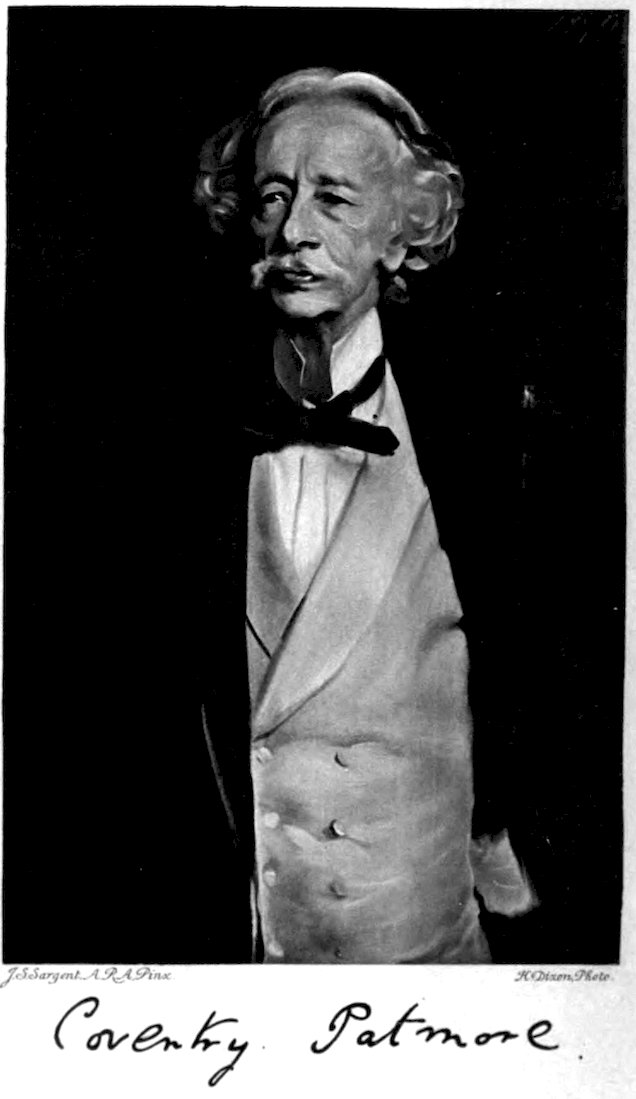
J. S. Sargent, A.R.A. Pinx K. Dixon, Photo
Transcriber’s Note:
New original cover art included with this eBook is granted to the public domain.
J. S. Sargent, A.R.A. Pinx K. Dixon, Photo
This book does not offer a selection in the usual sense. The poetry of a master is selected before it is written, and before it is conceived; and the mind that conceives it is selected. Mr. Coventry Patmore’s art and labour do but second that original distinction. Therefore it is hardly necessary to say that my intention has not been to make a collection of “best passages.” What has been intended is to collect passages in which the poet has dealt with two things—delight and sorrow, those human and intelligible passions to which all real poetry has access, but which this poetry touches so close as to be mingled with them and changed into them.
So to offer great poetry to the natural human sensibility, should be to gain for the poet’s whole work new readers. I confess that is my motive. viBecause of their youth, which has not allowed them to read very much, or because of accident, there may be many readers still to gain. Among them may be the fittest—not the less fit because they have been for a time under the influence of a fashion for inordinate haste, or for inordinate leisure, of appreciation. Mr. Patmore’s greatest work is neither so new as to gratify the eagerness of one fashion, nor so old as to flatter the reluctance of the other. It is a work of the beginning of the last quarter of our century. It is dated later than Mr. Swinburne’s best, for instance, but it had its place in literature before the present young love of poetry had taken life. Again, many poets are heard because a chorus of contemporaries sings with them and like them. Mr. Coventry Patmore’s voice is single in his day, and single in our literature. It makes part of no choir loud by numbers, and so it needs an attentive ear. To that attentive ear it sounds alone, as the divinest voice of our time.
There is a dignity in Mr. Patmore’s reputation (attendant on the exceeding dignity of his art) that might be offended—though it could not be viiinjured—by officious praises. But it is not inopportune to say thus much: Readers of this book and of the entire poems may be promised a perfect respite from the tedious controversy as to matter and manner, thought and expression. They shall not be invited to attend to discussions as to the relative importance of two things that in truth have no high importance if they can be divided so as to be merely related. The dispute is an inconsiderable one; it is perfectly opportune in the criticism of all poetry below a certain perfectly definite standard of art, and there only. Above that standard, thought and form are not opposed, nor merely related; they are one. It is not difficult to make a definition of classical poetry, if classical poetry may rightly be defined as all poetry—be its thought what it may, and its form what it may—in which thought and form are one. Classical poetry of every age—and every age has had a little—is that in which there is no antithesis, in which there is more than a bond—union and fusion. The classical poem may be a mere “To Althea from Prison,” or even a mere “To Blossoms.” In the small classic the word is fused with its fancy, and in the great viiiit is fused with its passion; and the greater the passion the greater the splendour of the fire of that fusion—the “integrity of fire.”
The more essential passages of Mr. Coventry Patmore’s much earlier work—The Angel in the House—are classic, and very high in that noble rank. He plays with this power of his art in the brief metre, the symmetrical stanza, and the colloquial phrase. He has here accepted the dailiest things and made them spirit and fire. There has been something said against these colloquialisms; and indeed they would not be tolerable in hands less austere and sweet. The newest Philistine, who is afraid of the reproach of Philistinism, who denies Philistinism in the name of a Philistine, and ultimately receives a Philistine’s reward, has been known to make light of some of Mr. Patmore’s couplets, which he finds too “domestic.” But such “domestic” couplets as those in “Olympus,” for instance, are a smiling defiance of Philistinism. So are the brilliant stanzas, made of life, sense, and spirit, in which the very accessories,—the spoilt accessories—of a modern English wedding are rendered grave and blithe, and the bridegroom ixis restored to the dignity of the sun. Mr. Patmore makes the Wedding Sermon (at the close of The Angel in the House) the improbable opportunity for the finest wit and thought, tenderness, mystery, and celestial knowledge. One of the things that have baffled the trivial in these early poems is probably what they have taken for triviality or artlessness in the metre as well as in the word. Locks and bars and bolts are less secure for the locking away of a poet’s privacy, than is his unintelligible candour. In his solemnity the world recognises a mystery; but by his frank play and simplicity it is sometimes baffled and misled into disregard.
The Odes are greater than the earlier poems, because they have greater capacity for the quality that is in all Mr. Patmore’s work. As for their metre, it is their very poetry. They move with indescribable dignity, and with the freedom of the spirit. The wind bloweth where it listeth. With absolute art the poet sighs, or pauses, or recovers breath, in the “irregular” line, with an effect of infinite liberty and pathos. “Thou hearest the sound thereof.” One of Mr. Patmore’s worthiest xcontemporaries has said that the Odes are almost too mournful to be read, because they are so close to the thought: “the verse attending on the thought, and having no independent life of its own.” This appreciation is insufficient, for there is union rather than “attendance;” but it expresses hastily the effect of this most sensitive and vital line—precisely the effect, which, in another art, results from the phrases of a Parsifal. Take the regular stanza as answering to a symmetrical melody; you will perceive that neither stanza nor tune can be so immediately sensitive as are those sentences of music, and those lines of the ode in the hands of a master. No other metrical form could be so free and so living a communication.
What is here to be communicated is vital and mortal pathos and felicity. Even as far as the reader has capacity to perceive that passion, he is aware that it is greater than his experience, and he confesses that it was uttered out of a greater capacity than his. Compassion with that greater passion is a high and worthy manner of admiration. It may be the “terror” that Aristotle joined to xi“pity.” Compassion in the highest degree is the divinest form of religion. The compassion of the slighter acquaintance with sorrow for the greater, and of the smaller capacity for the vaster, is a remorse of tenderness, lowliness, and respect, the paradox of worship.
Dexterity—the lower technique—may become habitual, and the more brilliant kinds of habit are often mistaken for the actual intention of great art; but great art is never habitual. Art has a perpetually living intention. All the lines and passages here gathered together are proofs of this instancy of art. And they are chosen as instant communications of the two passions of happiness and pain, because these are the most simple. It would have been easy to represent Mr. Patmore by an anthology proving him the poet of wit, or the poet of beauty, or the poet of indignation. But the most classic subject of classic poetry is the most intelligible in kind, however enormous in degree—felicity and infelicity. Of melancholy—the black humour—none of Mr. Patmore’s work has a sign.
| To the Unknown Eros | Page 1 |
| England | 5 |
| Remnant of Honour | 8 |
| Victory in Defeat | 9 |
| Saint Valentine’s Day | 12 |
| The Wedding Sermon | 15 |
| The Paragon | 16 |
| The Rose of the World | 18 |
| The Lover | 21 |
| Heaven and Earth | 23 |
| The Letter | 24 |
| The Revelation | 27 |
| The Doubt | 28 |
| Security | 29 |
| The Spirit’s Epochs | 30 |
| The Maid | 31 |
| Acceptance | 32 |
| Betrothed | 33 |
| xivThe Dance Page | 34 |
| Entreaty | 36 |
| The Revulsion | 37 |
| Praises | 40 |
| Marriage | 41 |
| The Rosy Bosom’d Hours | 42 |
| Wind and Wave | 45 |
| Beata | 47 |
| If I were Dead | 48 |
| Deliciæ Sapientiæ de Amore | 49 |
| Mignonne | 55 |
| Mildred | 57 |
| Rejected | 58 |
| Love in Tears | 59 |
| Denied | 60 |
| Love’s Will be Done | 61 |
| First Love Remembered | 62 |
| Lost Love | 65 |
| Away | 66 |
| Rachel | 72 |
| The Voice of One I Knew | 73 |
| In the Woods | 75 |
| Leah | 77 |
| Her Counsel | 78 |
| Sponsa Dei | 79 |
| Bonds | 82 |
| xvTo the Body | 83 |
| Auras of Delight | 86 |
| Psyche | 88 |
| Dawn | 89 |
| The Edge of Bliss | 90 |
| Eros | 91 |
| Amelia | 92 |
| After Storm | 96 |
| Venus and Death | 98 |
| Semele | 99 |
| The Married Lover | 100 |
| The Amaranth | 102 |
| The Letters | 103 |
| One Spring | 109 |
| Ma Belle | 111 |
| A Farewell | 112 |
| Departure | 114 |
| The Azalea | 116 |
| Eurydice | 118 |
| The Day after To-Morrow | 121 |
| Tired Memory | 124 |
| The Toys | 128 |
| Winter | 130 |
| L’Allegro | 133 |
| A Retrospect | 136 |